
The Difference Between Commentary and Intelligence
What trained intelligence work does that public commentary cannot. The free article.

The Difference Between Commentary and Intelligence
What trained intelligence work does that public commentary cannot.
By Matthew Lonsdale
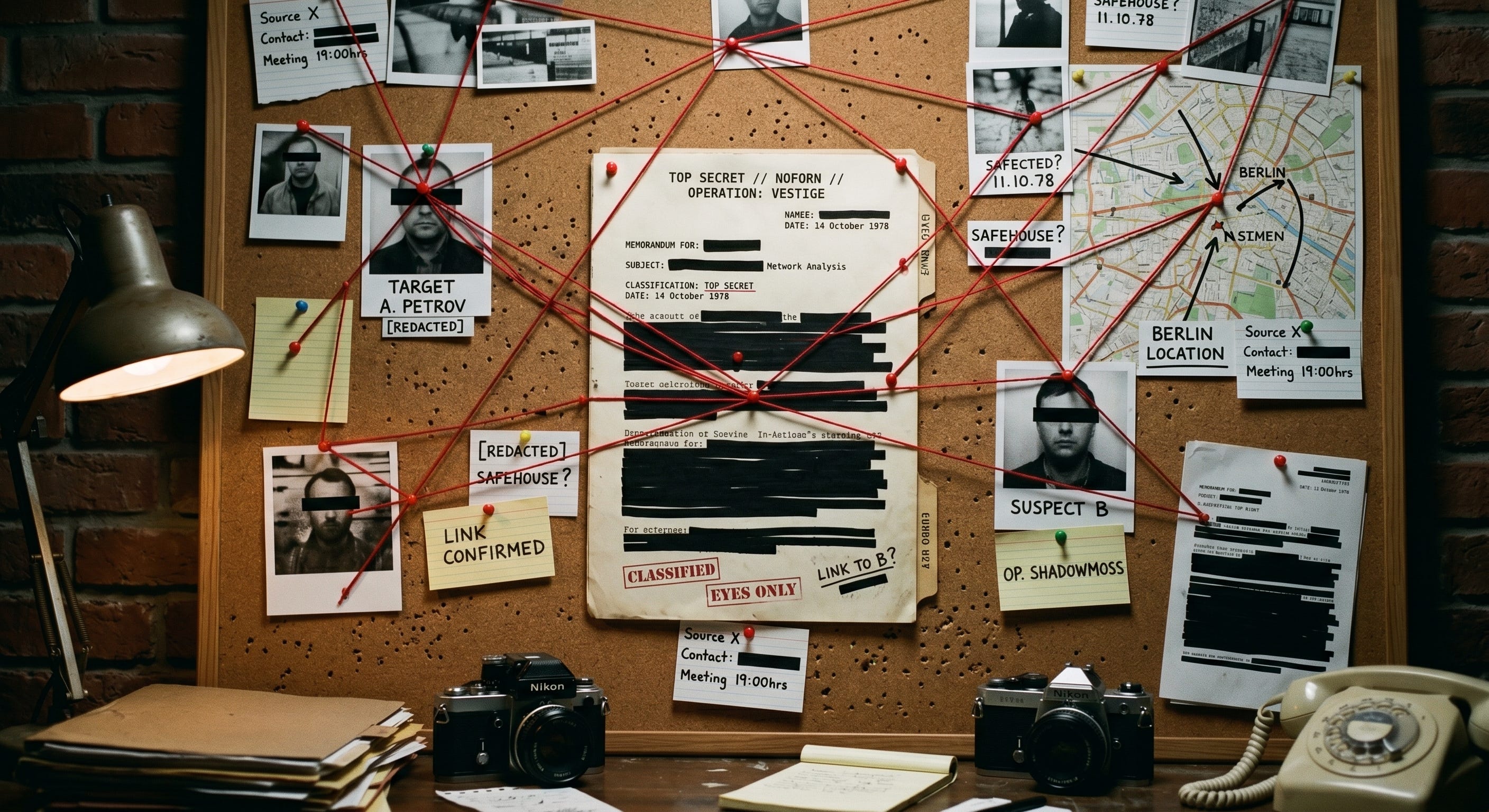
Most of what you read about in the geopolitical landscape is opinion writing dressed as analysis. There is nothing wrong with opinion writing. There is a great deal wrong with mistaking it for analysis.
The two are built differently.
Opinion writing starts with a position. It selects supporting evidence. It dismisses or ignores evidence that contradicts the position. It closes with a confident conclusion that aligns with the writer’s prior commitments. The structure rewards confidence, narrative coherence, and rhetorical force. It punishes calibration, hedging, and admission of uncertainty. The economics of public attention have ruthlessly selected for it over the last decade.
Intelligence work runs the other way. It starts with a question. It assembles evidence without selecting for the answer. It tests evidence against multiple hypotheses simultaneously, including the ones the analyst would prefer were wrong. It calibrates confidence based on the strength and convergence of the evidence, not the writer’s preference. It states explicitly where the evidence is thin, where alternative readings remain alive, and what would change the assessment.
The output looks different. It reads slower. It hedges in specific places and refuses to hedge in others. It treats the reader as someone who will use the assessment to make a decision, not as someone who needs to be entertained or persuaded.
The discipline is not natural. It has to be trained. The training takes years of practice and application.
This publication is the public version of that discipline, applied weekly to the strategic environment that affects Australia. This is the only free piece. After this, the work goes behind the wall, because what I do is what professionals pay for. Before any of that, I owe you a straight answer to one question.
What is actually different about how an intelligence professional reads the world, and why does that difference matter to you?
What practitioner-grade work does
Trained intelligence work has a small number of habits that distinguish it from commentary, regardless of subject.
It separates assessment, judgement, and speculation. An assessment is a conclusion supported by evidence with confidence calibrated to the strength of that evidence. A judgement is a professional opinion in an area where evidence is incomplete but the analyst’s training and experience contribute weight. Speculation is everything beyond. Commentary blurs the three. Practitioner work does not.
It calibrates confidence explicitly. High confidence. Moderate confidence. Low confidence. Each carries a specific meaning about the strength and convergence of underlying sources. A reader who understands the calibration can use the assessment to make decisions in ways they cannot with confidently-stated commentary.
It runs multiple hypotheses in parallel. The single biggest cognitive failure in public analysis is anchoring on the first plausible explanation and then assembling evidence to support it. Practitioner work generates competing hypotheses early and tests the evidence against all of them, including those the analyst would prefer were wrong.
It reads documents as written, not paraphrased. Strategic documents, ministerial speeches, defence policy releases, and capability decisions are not read for what they announce. They are read for what they concede, what they leave out, where the language is doing work, and what the gap between approved and unapproved tells you about the constraints under which the writers were operating.
It separates content from architecture. Public messaging by states and major institutions is content delivered through a designed architecture, aimed at multiple audiences simultaneously, optimised for some objectives and constrained by others. Reading the architecture is a different skill from reading the content. Most commentary reads the content. A properly trained practitioner reads both.
It admits when it does not know. The most reliable signal of practitioner-grade work is the analyst’s willingness to say I do not have enough evidence to assess this with confidence. Here is what I would need to see. Commentary almost never does this. The economics of attention reward confidence and punish calibration. Practitioner work does it because the alternative is to write things that are wrong.
These habits are not exotic. They are the basic discipline of every credentialed intelligence training program in the Five Eyes. They are also almost entirely absent from the public information environment.
Why the gap matters more now
The case for trained analysis used to rest on the complexity of the subject matter. Strategic affairs were specialised, the events were rare, the audience was small, and the cost of getting the read wrong was contained.
None of those conditions still hold.
Strategic affairs are now embedded in everyday economic and political life. The price of fuel in Australia is a function of decisions made in Tehran, in Washington, and in straits twelve thousand kilometres away. The reliability of cloud infrastructure is a function of its cable architecture, which is vulnerable to state and proxy attacks. The viability of a critical minerals contract is a function of sanctions regimes that change with administrations. The labour market for engineers is a function of submarine-industrial-base decisions made fifteen years ago in three countries.
The events are no longer rare. The Middle East, Europe, and the Indo-Pacific are all generating events of strategic significance every week, in parallel. A reader trying to follow this through traditional commentary is consuming somewhere between 30 and 100 opinions per week, almost all of them written under deadline pressure by people whose priors are visible from the third paragraph.
The audience is no longer small. The decision-makers who used to receive professional intelligence assessments through institutional channels can no longer get what they need that way. Government assessments are slower than the news cycle. Institutional analysis is constrained by funding and by the political sensitivities of the institutions that produce it. Commercial intelligence is expensive and selective in what it covers. The gap is being filled, badly, by commentary that looks like analysis and is not.
The cost of getting it wrong is no longer contained. Decisions made on the basis of confidently wrong analysis compound into supply chain failures, capital allocation errors, workforce planning miscalculations, and policy commitments that take years to unwind. The cost is now being borne by organisations that bought confident answers when they should have bought calibrated ones.
This is the gap Grey Zone Brief is built to close.
The information environment and why reading it requires training
The single largest analytical shift of the last decade is that the information environment is no longer a neutral medium through which strategic affairs flow. It is a contested space in its own right.
States, proxies, platform-native operations, paid amplification networks, genuine voices, and unintentional amplifiers all interact in ways that are not visible without training. A statement issued by a foreign ministry is one component of a designed message. Its amplification across state media, friendly foreign press, social platforms, and proxy commentators is a different component. The contradiction between that statement and the operational behaviour of the same state’s military or paramilitary forces is a third component. Reading any one of these on its own produces a partial picture. Reading them together accurately requires a discipline developed within intelligence organisations and is rarely available in public commentary.
I hold formal Australian Defence Force qualifications in psychological operations at both the Operator and Manager levels. I have not used them in live deployments. The training itself is what informs my reading of the global information environment.
The training does three specific things.
It allows the analyst to filter mis-, dis-, and malinformation in a deliberately constructed environment. State media, proxy amplifiers, platform-native information operations, paid influence campaigns, and unintentional amplification by genuine voices all interact. Identifying which components of a narrative are genuine signals, which are controlled amplification, which are composite messaging designed for different audiences, and which are unintentional disclosure is a trained skill, not an instinct.
It allows the analyst to read the same event from multiple cognitive frames simultaneously. Information influences attitudes, behaviours, and beliefs through specific mechanisms. The training covers those mechanisms. The result is the ability to read current events through left-leaning and right-leaning frames simultaneously, not as a political exercise but as an analytical one. The analyst can see which audience a piece of content is constructed to reach, why it is constructed that way, and what the underlying assumptions about the target audience reveal about the sender. This capability is non-partisan. It is used to separate the content of an argument from the architecture of its delivery.
It allows the analyst to apply an OSINT-plus-information-operations lens to adversary messaging. Open-source intelligence collection without an information operations lens produces data. With the lens, it produces meaning. The analyst can identify the messaging architecture behind state announcements, detect when that architecture is functioning and when it has broken, and read the implications for policy without waiting for events to play out kinetically.
This is the lens that distinguishes Grey Zone Brief from the broader public conversation on strategic affairs. It is the part of the work that is hardest to find elsewhere and produces the most differentiated output.

What this publication does
Grey Zone Brief reads strategic events as they are read within intelligence organisations. The mission has three layers.
What is really happening. The publication surfaces observable events that are strategically significant but under-covered, and reads them accurately rather than through ideological or commercial distortion. It identifies what most coverage misses, where consensus framing is wrong, and which seemingly small stories will matter most in 90 days.
What it means from an Australian perspective. Australian audiences are underserved by international commentary on defence and intelligence. A US-weighted frame treats the Indo-Pacific as one of several regions; an Australian frame treats it as the region. A European frame treats Russia-Ukraine as the war of our time; an Australian frame treats it as a war whose supply-chain implications reshape our critical-minerals strategy. Grey Zone Brief does not translate international coverage for Australian readers. It writes original analysis from the Australian vantage point.
What to do about it. Every long-form piece closes with implications. Not platitudes. Specific observations about what the analysis means for individual citizens making decisions about their own security, investment, or employment; for policymakers; for industry, particularly in defence, resources, technology, and critical infrastructure; and for partner forces and allied organisations where the analysis is relevant.
The publication produces long-form written and video content, as well as shorter-cycle output, throughout the week. Premium analysis, deeper assessments, and quarterly intelligence reports live behind the paid tier, where serious work belongs.
This is the only piece outside the wall.
The standard
The seat I write from is specific. It does not reproduce easily.
That seat carries certain obligations. I will not romanticise the work I did, the regiment I served in, or the institutions I came out of. I will not perform certainty I do not have. I will not write to a political audience because I do not have one. I will calibrate confidence the way the discipline requires, and I will tell you when I am guessing. Where I am wrong, I will say so in the next piece. Where I have been right, I will not crow about it.
The standard I am holding myself to is the one I held my analysts to when they wrote for me. Would a general, diplomat or operator who staked their decision on this assessment feel they were served well by the work?
That is the standard. That is the bar.
The world is sideways. Australia’s strategic situation is more fluid and more dangerous than it has been in my professional lifetime. Reading it correctly matters.
That is what this publication is here to do.
Welcome to Grey Zone Brief.

About
Matthew Lonsdale spent 16 years in the Australian Defence Force, including 5 as an intelligence professional within Special Operations Command, and subsequently served as an Intelligence Instructor.
His operational footprint includes the Middle East in 2019 on Operation AUGURY, reachback support to Operation OKRA from Brisbane in 2016 and 2017, Ukraine in February 2022 on embassy evacuation planning ahead of the Russian invasion, Poland and Germany later in 2022 supporting Australia’s lethal aid contributions to Ukraine, and prior service in Timor-Leste, Thailand, Indonesia, and New Zealand.
He holds Australian Defence Force Psychological Operations qualifications at both Operator and Manager levels. He is qualified through ANZCTC Joint Counter Terrorism Team training (JIGOSEC and JAGSEC) and holds Australian and New Zealand Defence Force intelligence credentials. His professional capabilities include live targeting, network analysis, and the development of a proprietary intelligence methodology that identified previously unidentified hostile actors, traffickers, and financiers participating in global terrorism.
He has been recognised with the United States Joint Service Commendation Medal and twice with Australian Defence Force commendations.
He is the Founder and Managing Director of SURGE Intelligence, a Perth-based strategic intelligence advisory working with critical infrastructure operators and executive principals across Australia. He is completing postgraduate studies in National Security Policy at the Australian National University National Security College.